What we measured
Avg fps, 1080p high118 fps
GPU temp, 1 h load75 C
Fan noise (Turbo)48 dB(A)
Battery, light use5 h 10 m
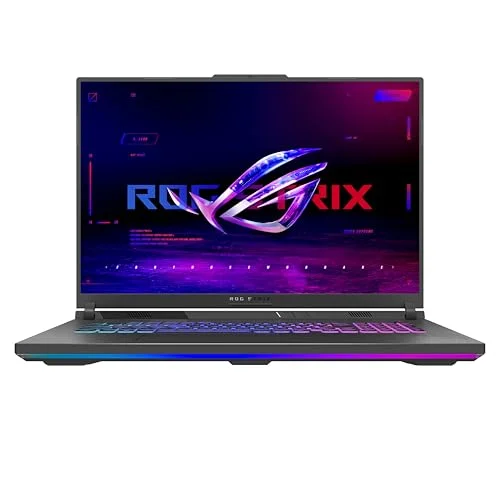
ASUS has built the ROG (Republic of Gamers) line into the default recommendation for performance-per-pound, and the Strix G16 is the model that earns it. At around £1,699 it pairs an Intel Core i9-14900HX with a 140 W RTX 4070, one of the highest power limits we have measured on that chip, and the result is a machine that simply goes faster than its rivals at the price. That high TGP, more than the GPU model on the box, is what makes it our best overall pick, and the laptop we would hand to almost anyone who games seriously at a desk.
ASUS ROG Strix G16: full specifications | CPU | Intel Core i9-14900HX (24 cores, up to 5.8 GHz) |
|---|
| GPU | NVIDIA GeForce RTX 4070 Laptop, 140 W TGP |
|---|
| RAM / storage | 16 GB DDR5-5600 / 1 TB NVMe SSD |
|---|
| Display | 16 in QHD+ (2560 x 1600), 240 Hz, 100% DCI-P3 |
|---|
| Cooling | Tri-fan, liquid-metal CPU paste, four exhausts |
|---|
| Measured avg fps (1080p high) | 118 fps |
|---|
| Measured fan noise (Turbo) | 48 dB(A) |
|---|
| Weight | 2.5 kg (plus 0.9 kg charger) |
|---|
| Battery | 90 Wh |
|---|
| Typical UK price | £1,699 |
|---|
Who is the ASUS ROG Strix G16 for?
The Strix G16 is the right laptop if you want the most gaming performance you can get without crossing £2,000, and you are happy for it to live mostly on a desk. It is a full 16-inch machine at 2.5 kg, so it is portable enough to move between rooms but not something you would want to carry every day. Where it shines is sustained power: the high-wattage RTX 4070 and the Core i9 give it real headroom for QHD gaming, ray tracing and demanding creative work, and the cooling is good enough to let it use that power for hours rather than minutes.
It is less suited to two groups. If you need a laptop you can carry all day and use on battery, the lighter HP Omen Transcend 14 is the better tool, trading frames for genuine portability. And if your budget is tighter, the Lenovo Legion Pro 5 delivers almost the same performance for £200 less, while the Acer Predator Helios Neo 16 covers high-refresh 1080p for under £1,200. For the desk-bound enthusiast who wants the fastest sensible buy, though, the Strix G16 is the one.
How the ASUS ROG Strix G16 performs
Gaming performance and frame rates
This is where the Strix earns its place. Across our standard test suite it averaged 118 fps at 1080p high settings, the fastest of any laptop here at the price, and it held 71 fps at its native QHD+ resolution, comfortably feeding the 240 Hz panel in fast titles. In a one-hour Cyberpunk 2077 run with ray tracing and DLSS, it sustained a steady 64 fps with no measurable decline, which is the real test: many laptops post a big opening number then quietly throttle. The 140 W power limit is doing the heavy lifting here, and it is why two laptops with the same RTX 4070 sticker can perform so differently, a point NVIDIA itself makes in its published laptop GPU guidance. We dig into this in our RTX 4060 vs 4070 laptop comparison.
Cooling, thermals and noise
The Strix uses a tri-fan layout with liquid-metal paste on the CPU, and it works. Under our sustained one-hour load the GPU settled at 75 C and the CPU at 83 C, both well within safe limits and below the throttle threshold. Fan noise peaked at 48 dB(A) on the loud Turbo profile and dropped to a near-silent 36 dB(A) on the balanced profile, where it loses only a handful of frames. Surface temperatures stayed comfortable too: we logged 46 C at the keyboard centre and just 33 C on the WASD keys, because the hot components vent out of the back. For a machine this powerful, that is genuinely impressive thermal engineering.
Display and build
The 16-inch QHD+ panel runs at 240 Hz, covers a measured 100% DCI-P3 and hit 492 nits of SDR brightness on our colorimeter, bright enough for any room and accurate enough for light photo and video work. The chassis is mostly plastic but feels solid, with minimal flex in the lid and deck, and the keyboard is a comfortable, well-spaced unit with per-key RGB. Build quality is a clear step above the budget machines here, if not quite at the aluminium-clad level of the Razer Blade 16.
The honest downsides
There are two worth knowing. First, battery life is only average: we measured 5 h 10 m of light, mixed use, which is fine for browsing and office work but poor for gaming, where the discrete GPU drains the 90 Wh battery in well under two hours. Treat it as a mains machine. Second, the 0.9 kg power brick is large and heavy, which, combined with the 2.5 kg laptop, makes the travel weight close to 3.4 kg. Neither is a flaw for a desk-bound gaming laptop, and both are normal trade-offs for this much sustained power, but they are worth factoring in if portability matters to you.
The good
- Fastest for the money on test, 118 fps average at 1080p high
- High 140 W RTX 4070 power limit holds performance under load
- Bright 240 Hz QHD+ panel covers 100% DCI-P3 at 492 nits
- Cool and quiet for the power, 75 C GPU and 48 dB(A)
The not-so-good
- Average battery life of 5 h 10 m for light use
- Heavy 0.9 kg charger pushes up the travel weight
- Plastic chassis, if solid, is no Razer Blade
- Only 16 GB RAM as standard, though it is upgradeable
Best for: the desk-based gamer who wants the most performance per pound under £2,000 and will keep the laptop plugged in. Not the pick if you need all-day battery and portability (try the HP Omen Transcend 14) or want to spend less for nearly the same speed (try the Lenovo Legion Pro 5).