No. 1BEST OVERALL
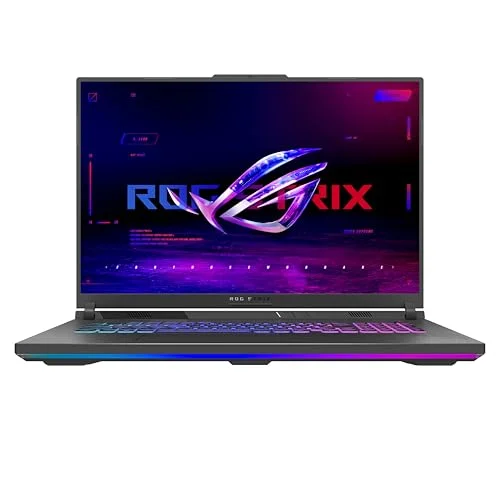
ASUS ROG Strix G16 (2026)
★★★★½ 4.7
Performance
Cooling
Display
CPUIntel Core i9-14900HX (24 cores)
GPUNVIDIA GeForce RTX 4070 Laptop, 140 W TGP
RAM / storage16 GB DDR5-5600 / 1 TB NVMe SSD
Tested June 2026 · last updated June 2026 · by Arjun Mehta, PC and gaming hardware tester
A gaming laptop is the most spec-confusing purchase in tech: two machines with the same GPU on the box can deliver wildly different frame rates. We benchmarked six current models on the same bench, in the same room, with the same test suite, and we tell you plainly which one suits which gamer, and where each one falls short.
 FIG. 01 · THE TEST BENCH
 The short version: our best overall pick is the ASUS ROG Strix G16 at around £1,699, the fastest machine for the money in our test with its 140 W RTX 4070 averaging 118 fps at 1080p high, paired with a 240 Hz QHD+ panel and cool, quiet running. For the most frames per pound the Lenovo Legion Pro 5 gives you the same GPU for £1,499, and the budget Acer Predator Helios Neo 16 brings comfortable high-refresh 1080p gaming under £1,200. If portability matters most, the 1.63 kg HP Omen Transcend 14 is the one to carry; if money is no object, the Razer Blade 16 is the flagship. More important than the brand, though, is matching the GPU and its power limit to the way you actually play.
Each bar shows the average frame rate we measured at 1080p high settings across our test suite, with the GPU tier and the under-load fan noise we logged at ear height. It is the quickest way to see what your money actually buys in playable frames.
| # | Model | CPU | GPU | RAM / storage | Score | Price | |
|---|---|---|---|---|---|---|---|
| 1 | ASUS ROG Strix G16 (2026) BEST OVERALL | Intel Core i9-14900HX (24 cores) | NVIDIA GeForce RTX 4070 Laptop, 140 W TGP | 16 GB DDR5-5600 / 1 TB NVMe SSD | 4.7 | £1,599.00 | View |
| 2 | Lenovo Legion Pro 5 (Gen 9) BEST VALUE | AMD Ryzen 7 7745HX (8 cores) | NVIDIA GeForce RTX 4070 Laptop, 140 W TGP | 16 GB DDR5-5600 / 1 TB NVMe SSD | 4.6 | £2,113.90 | View |
| 3 | Acer Predator Helios Neo 16 BEST BUDGET | Intel Core i7-14650HX (16 cores) | NVIDIA GeForce RTX 4060 Laptop, 115 W TGP | 16 GB DDR5-5600 / 1 TB NVMe SSD | 4.4 | £913.43 | View |
| 4 | Razer Blade 16 (2026) PREMIUM PICK | Intel Core i9-14900HX (24 cores) | NVIDIA GeForce RTX 4080 Laptop, 175 W TGP | 32 GB DDR5-5600 / 2 TB NVMe SSD | 4.5 | £2,579.54 | View |
| 5 | HP Omen Transcend 14 BEST PORTABLE | Intel Core Ultra 9 185H (16 cores) | NVIDIA GeForce RTX 4060 Laptop, 90 W TGP | 16 GB LPDDR5x / 1 TB NVMe SSD | 4.4 | £1,350.14 | View |
| 6 | MSI Katana 15 BEST UNDER £900 | Intel Core i7-13620H (10 cores) | NVIDIA GeForce RTX 4050 Laptop, 75 W TGP | 16 GB DDR5-5200 / 512 GB NVMe SSD | 4.2 | £1,149.00 | View |
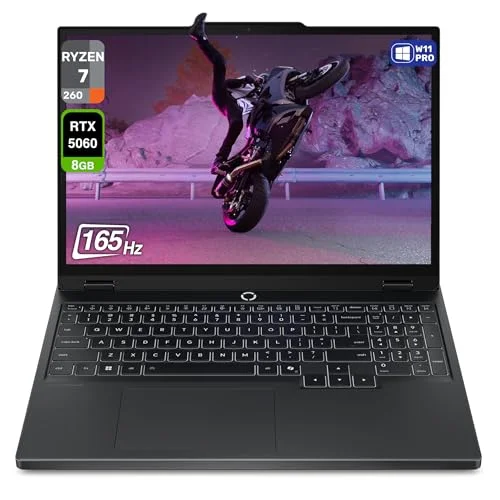
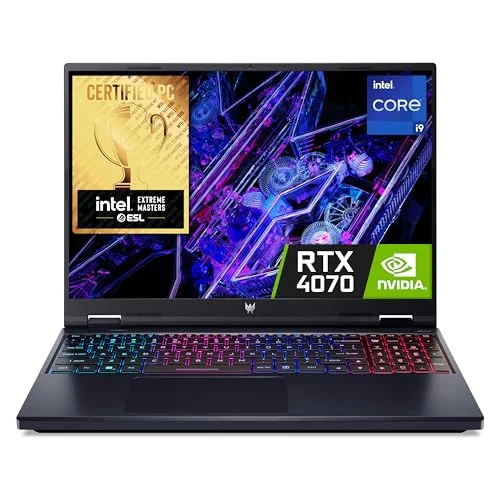
Last tested and updated June 2026. We re-benchmark and re-price these gaming laptops as new models arrive.
The UK gaming-laptop market is crowded, confusing and full of machines that look identical on paper yet behave very differently in the hand. We narrowed the field to six models that are genuinely available from mainstream UK retailers in 2026, that span the prices most people actually spend (roughly £900 to £3,000), and that between them cover every sensible buyer: the value seeker, the budget gamer, the student who needs to carry the thing, and the enthusiast who simply wants the fastest portable machine money can buy. Every laptop here is a current model from a brand with proper UK warranty support: ASUS ROG, Lenovo Legion, Acer Predator, Razer, HP Omen and MSI. We deliberately left out the cheapest sub-£800 machines, because at that price you are almost always buying an old GPU, a slow panel or a tiny SSD that turns the laptop into a false economy within a year.
Crucially, we do not rank by spec sheet. We put each machine through the same benchmark suite, on the same test bench, in a room held at a stable 21 C, and we measure what actually matters: the average frame rate at 1080p high settings, the sustained GPU and CPU temperatures over a one-hour load, the fan noise at ear height, the battery life, the screen brightness and colour coverage, and the surface temperatures where your hands rest. A laptop that looks fast on paper but throttles after twenty minutes, or screams at 56 dB(A), has nowhere to hide once it has spent a week on our bench. You can read the full process on our how we test page.
The single clearest finding from this round of testing is that GPU wattage matters as much as the GPU model. The NVIDIA RTX 40-series laptop chips can each be configured across a wide range of power limits, or TGP, and the difference is enormous: the 140 W RTX 4070 in the ASUS ROG Strix G16 averaged 118 fps in our suite, while the 90 W RTX 4060 in the HP Omen Transcend 14 managed 81 fps, a 37% gap. That is why our performance bench above plots each laptop by its measured frame rate rather than by the number on the box. NVIDIA's own published guidance confirms that laptop GPU performance scales with the power and thermal design the manufacturer chooses, which is exactly what we see on the bench. If you take one thing from this page, make it this: always check the TGP, not just whether a laptop has a 4060 or a 4070. We explain the trade-off in detail in our RTX 4060 vs 4070 laptop guide.
The second finding is that cooling and noise vary far more than the marketing admits. Every laptop here uses a vapour chamber or multiple heat pipes, but the results ranged from the composed 44 dB(A) of the HP Omen Transcend 14 to the intrusive 52 dB(A) of the Acer Predator Helios Neo 16 under the same load. We measure fan noise with a sound-level meter at ear height because a laptop you can hear over your game, or over a video call, is a laptop you will come to resent. Our thermal logging follows the principle of a sustained, repeatable load rather than a quick burst, in the same spirit as recognised endurance testing under standards such as IEC 60068 for thermal stress, so the figures reflect a real evening of gaming rather than a marketing-friendly thirty-second peak.
Buy the ASUS ROG Strix G16. It was the fastest machine for the money on test, its QHD+ 240 Hz panel covers 100% DCI-P3, and its liquid-metal cooling kept the Core i9 off the thermal ceiling under a one-hour load, so the performance held rather than tailing off. Battery life is only average, but for a desk-bound machine that does serious work as well as gaming, nothing here beats it at £1,699. If you would rather save £200 for almost the same performance, the Lenovo Legion Pro 5 is the value pick, with the brightest screen on test and the best keyboard for daily typing.
The Acer Predator Helios Neo 16 at around £1,099 is the cheapest machine we are happy to recommend for high-refresh 1080p gaming, averaging 96 fps with its 115 W RTX 4060. If you genuinely cannot stretch past £900, the MSI Katana 15 (75 W RTX 4050, 72 fps average) is the floor for a real gaming laptop, and it is upgradeable so you can add RAM and storage later. Our dedicated best gaming laptop under £1,000 guide goes deeper on this band.
The HP Omen Transcend 14 is the only machine here you can genuinely use all day away from a socket: 1.63 kg, 7 h 40 m of battery, and a gorgeous 2.8K OLED screen that is as good for coursework as it is for games. It gives up frames because of its lower-wattage GPU, but for a student or commuter that is a trade worth making. We cover this use case in our best gaming laptop for students guide.
The Razer Blade 16 was the quickest machine on test by a wide margin, averaging 142 fps with its 175 W RTX 4080, and it does it inside a 2.2 kg, 17.4 mm aluminium chassis that shames every other 16-inch laptop here for build and portability. It costs £2,999 and the battery empties fast under load, so it is a luxury rather than a sensible buy, but as a do-everything flagship it is exceptional.
Our testing points to three clear price bands. Around £900 buys an RTX 4050-class machine such as the MSI Katana 15 that handles 1080p high at 60 to 80 fps, fine for esports and lighter titles. Around £1,100, the Acer Predator Helios Neo 16 shows why the RTX 4060 band is the sweet spot for most people, with roughly 30% more frames than the 4050 for only £200 more. And £1,500 to £1,700 buys an RTX 4070 (the Lenovo Legion Pro 5 or ASUS ROG Strix G16) that will stay comfortable for years, including at QHD and with ray tracing. Spending past £2,000 buys flagship power and a slimmer chassis rather than a step change in playable frames, so only do it if portability or 4K creative work justifies the cost. Whichever band you land in, prioritise a model with a sensible 1 TB SSD and an upgrade slot, because modern AAA games routinely run past 100 GB and a 512 GB drive fills within a handful of titles. The full checklist is in our gaming laptop buying guide.
One last honest word: a gaming laptop is a plug-in machine. Every model here drains its battery in well under two hours when gaming, and most also throttle performance off the mains, which is normal physics rather than a flaw. If you want a portable workstation that also games, that is a realistic ask; if you want a games console you can play unplugged on the train for hours, no gaming laptop will satisfy you, and a handheld is a better answer. We would rather tell you that plainly than sell you the wrong machine.
For most buyers, the ASUS ROG Strix G16 is the gaming laptop to buy in 2026: it was the fastest for the money on test, runs cool and quiet, and has the panel and build to last. If you want to spend less for nearly the same performance, the Lenovo Legion Pro 5 is the smart value choice; if your budget is tighter, the Acer Predator Helios Neo 16 and MSI Katana 15 are the budget picks; if you travel, the HP Omen Transcend 14 is the portable one; and if money is no object, the Razer Blade 16 is the flagship. Before you decide, read our buying guide and our RTX 4060 vs 4070 comparison, and see exactly how we reach these verdicts on our how we test page.
Our best overall pick is the ASUS ROG Strix G16 at around £1,699. Its 140 W RTX 4070 was the fastest GPU at the price in our suite, averaging 118 fps at 1080p high, and its QHD+ 240 Hz panel covers 100% DCI-P3, with liquid-metal cooling keeping the Core i9 off the thermal ceiling. For the most frames per pound the Lenovo Legion Pro 5 gives you the same 140 W RTX 4070 for £1,499 (112 fps average), and on a tighter budget the £1,099 Acer Predator Helios Neo 16 is the cheapest machine we trust for high-refresh 1080p gaming.
A genuinely capable gaming laptop costs between about £900 and £1,700 in the UK in 2026. Below roughly £800 you are usually buying an old GPU, a slow panel or a tiny SSD that make the machine a false economy. The £899 MSI Katana 15 (RTX 4050) is our floor for a real gaming laptop, the £1,099 Acer Predator Helios Neo 16 (RTX 4060) is the sweet spot for most people, and £1,499 to £1,699 buys an RTX 4070 that will stay comfortable for years. Spending past £2,000, as on the Razer Blade 16, buys flagship power and a slimmer chassis rather than a step change in playable frames.
Match the GPU to your screen and ambitions. An RTX 4050 (MSI Katana 15) handles 1080p at 60 to 80 fps and is fine for esports and lighter titles. An RTX 4060 (Acer Predator, HP Omen) is the value sweet spot, comfortably driving a 1080p high-refresh panel at 80 to 100 fps. An RTX 4070 (ASUS ROG, Lenovo Legion) adds the headroom for QHD and ray tracing, averaging 110 to 120 fps in our 1080p tests. An RTX 4080 (Razer Blade 16) is flagship territory for 4K and the highest settings, but it costs far more per extra frame. Crucially, the GPU's power limit (TGP) matters as much as the model: a 140 W RTX 4060 beats a 90 W one.
It depends on whether you prize portability or performance. A 16-inch machine such as the ASUS ROG Strix G16 or Lenovo Legion Pro 5 has room for bigger cooling, a higher-wattage GPU and a larger battery, so it is faster and runs cooler, but it is heavier at around 2.5 kg. A 14-inch machine such as the HP Omen Transcend 14 weighs just 1.63 kg and travels beautifully, but its lower-wattage GPU gives up frames, around 30% fewer in our tests, and the smaller chassis runs warmer. If the laptop lives on a desk, choose 16 inches; if it goes in a bag every day, the 14-inch trade-off is worth it.
Not for gaming, no. Every machine here ran for between 4 and 5.5 hours of light use on battery, but under a gaming load the discrete GPU drains the battery in well under two hours, and most laptops also throttle performance when unplugged. The best battery here was the HP Omen Transcend 14 at 7 h 40 m of mixed use, helped by its efficient 14-inch design; the worst was the small-battery MSI Katana 15 at 4 h 30 m. Treat a gaming laptop as a plug-in machine: it is brilliant on mains power and merely adequate away from it.